FlowChat vs. HubSpot for Social Selling: Which CRM Wins for Outbound?
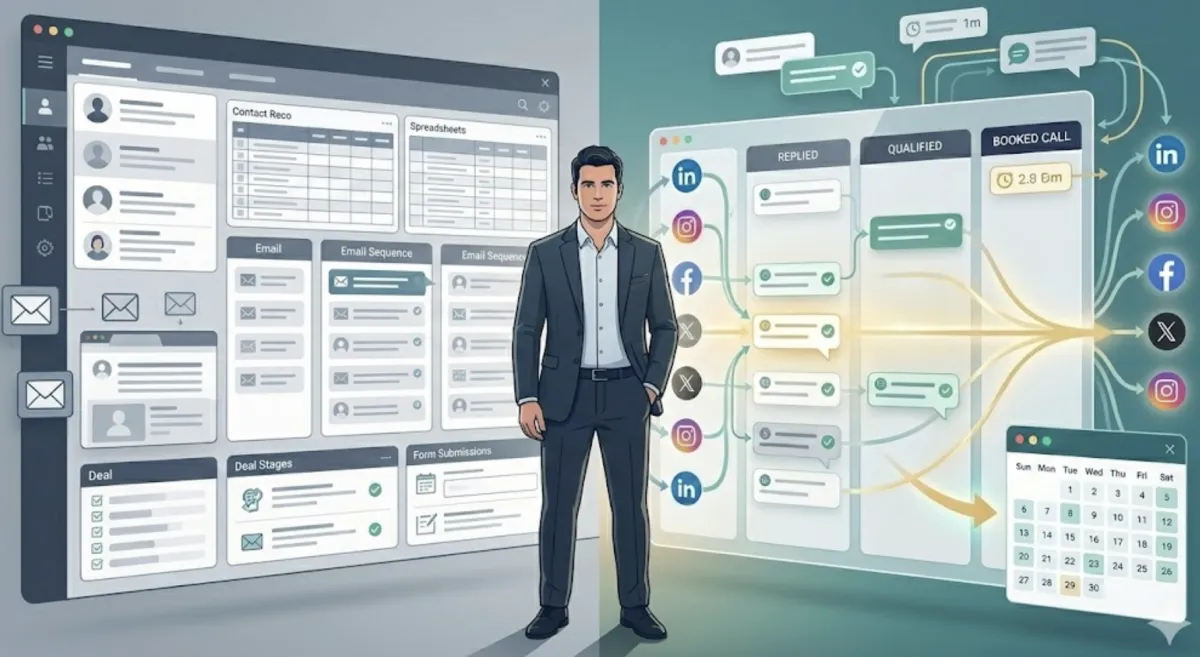
The Difference Between a Traditional CRM and a Smart Messaging OS
If you’re comparing FlowChat and HubSpot for social selling, you’re asking the right question.
Because the real decision isn’t:
“Which CRM is better?”
It’s:
“Do I need a traditional CRM… or a system built specifically for social prospecting and DMs?”
Let’s break it down clearly.
First: What HubSpot Is Built For
HubSpot is a powerful traditional CRM.
It excels at:
Email marketing
Sales pipeline management
Marketing automation
Contact databases
Reporting & attribution
If your primary revenue channel is:
Inbound forms
Email campaigns
Website funnels
Paid ads
HubSpot makes sense.
But social selling changes the workflow entirely.
What Social Selling Actually Requires in 2026
Social selling doesn’t live in forms.
It lives in:
LinkedIn DMs
Instagram messages
Facebook Messenger
X
YouTube comments
And those conversations are:
Fast
Unstructured
Multi-platform
Context-heavy
This creates a different operational challenge.
You don’t just need contact storage.
You need conversation management.
That’s where the difference begins.
FlowChat: Built for Sell by Chat®
FlowChat is not a traditional CRM.
It’s a Smart Messaging Operating System designed specifically for:
DM-based lead generation
Outbound prospecting
Social selling workflows
Multi-platform messaging
AI-assisted conversation management
Instead of asking:
“How do we store contacts?”
FlowChat asks:
“How do we move conversations to revenue?”
That’s a very different focus.
Core Differences: FlowChat vs HubSpot
Let’s compare directly.
1. Conversation-Centric vs Contact-Centric
HubSpot = Contact records with activity logs.
FlowChat = Real-time unified inbox across platforms with structured DM pipelines.
If your revenue is generated inside DMs, managing conversations in one unified interface matters more than storing contacts.
2. Multi-Platform DM Aggregation
HubSpot:
Email-first
Social integrations are limited
DMs are not the core engine
FlowChat:
Centralizes LinkedIn, Instagram, Facebook, and more
Tracks conversation stages
Flags stalled leads
Organizes follow-ups
For social prospecting, aggregation isn’t optional.
It’s foundational.
3. Outbound Workflow Design
HubSpot works well for:
Email sequences
Form-based lead capture
Inbound nurture
FlowChat is built for:
Structured outbound DM flows
Stage-based conversation progression
Automated follow-up reminders
AI-assisted messaging
If your strategy is outbound through social platforms, workflow structure matters more than email drip logic.
4. AI in Context
HubSpot AI supports:
Email drafting
Content generation
CRM insights
FlowChat AI focuses on:
DM drafting
Objection handling suggestions
Conversation summarization
Follow-up prompts
Sell by Chat optimization
The context is different.
One is email-centric.
The other is conversation-centric.
5. Complexity vs Focus
HubSpot is powerful, but broad.
It can feel:
Heavy
Complex
Expensive at scale
FlowChat is focused.
It’s built specifically for:
Founders
Agencies
B2B outbound teams
High-ticket closers
Less general marketing automation.
More direct revenue conversations.
When HubSpot Is the Better Choice
HubSpot makes sense if:
Your business is heavily inbound
You rely on forms and email nurture
You need enterprise marketing automation
Social DMs are not your primary sales channel
It’s a great traditional CRM.
But traditional CRM ≠ social selling OS.
When FlowChat Is the Better Choice
FlowChat wins when:
Your primary pipeline comes from DMs
You run outbound campaigns on LinkedIn
You sell high-ticket offers via chat
You need unified multi-platform messaging
You want structured Sell by Chat® workflows
If your revenue happens in conversations, you need infrastructure built around conversations.
The Bigger Shift: From CRM to Messaging OS
The modern sales stack is evolving.
Old stack:
CRM → Email → Calls.
New stack:
Social → DMs → Qualification → Calls → CRM.
FlowChat sits at the front of the pipeline.
HubSpot typically sits after qualification.
That’s the strategic difference.
Do You Need Both?
In many cases, yes.
FlowChat manages:
Prospecting
DM workflows
Follow-up
Social pipeline
HubSpot can manage:
Post-call deal tracking
Marketing automation
Customer lifecycle
They aren’t always competitors.
But they serve very different roles.
Final Thought
If you’re comparing FlowChat vs HubSpot for social selling, ask yourself:
Where does your revenue actually begin?
If it begins in DMs…
You need more than a contact database.
You need a structured messaging system.
Because social selling isn’t about managing records.
It’s about managing conversations.
And conversations drive revenue.
Happy Selling!
-sean 🔥🕺
P.S. Ready to build a smarter social selling system?
If your team relies on LinkedIn, Instagram, or multi-platform outbound…
It may be time to move beyond traditional CRM logic.
Centralize your DMs.
Structure your pipeline.
Engineer your follow-up.
Because in 2026, the companies that win won’t just track contacts.
They’ll master conversations.
Learn more about whether or not FlowChat fits what you're looking for by booking a call direct with our team: BOOK HERE.


