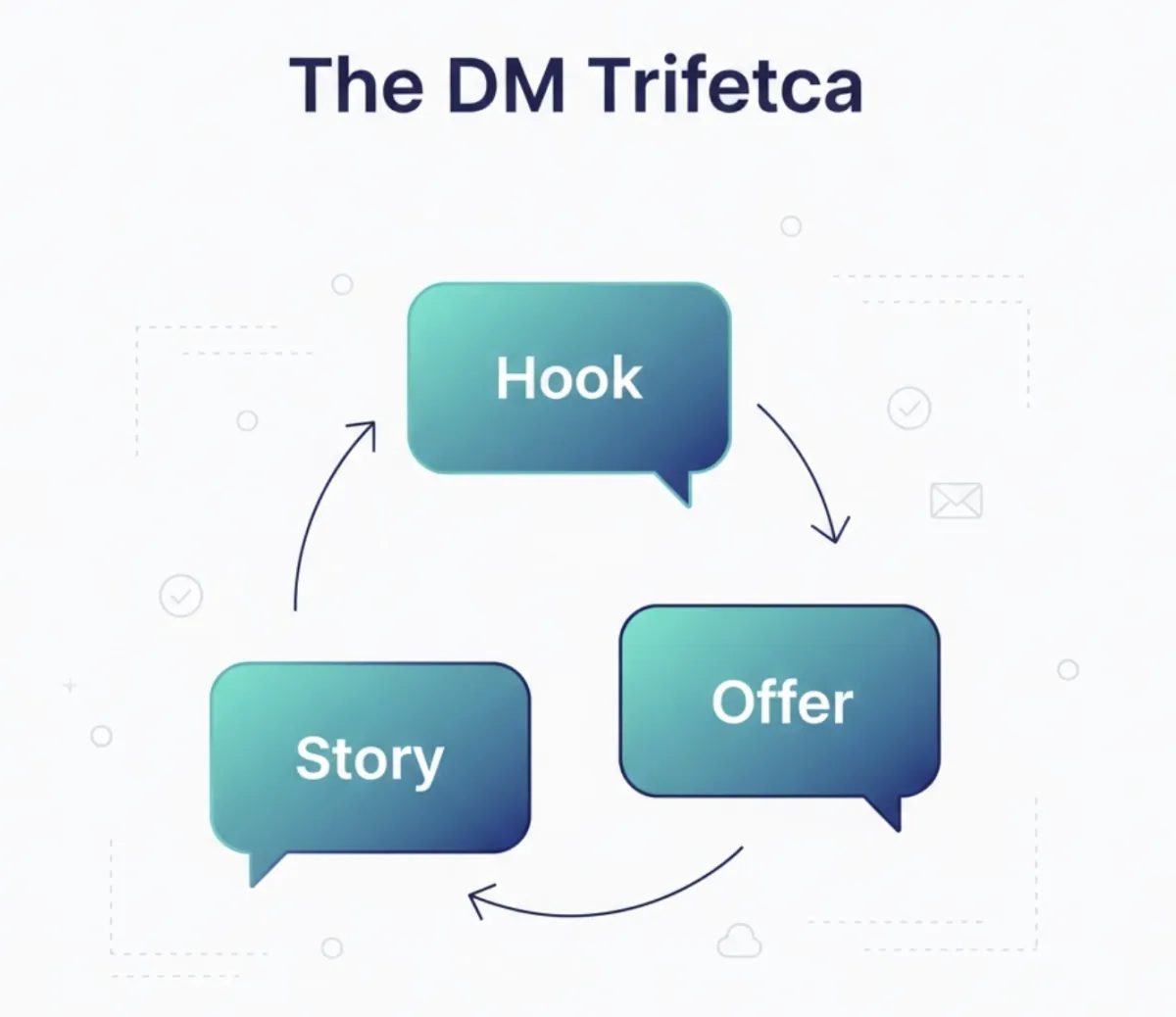
The DM Trifecta: How to Use Hook, Story, and Offer in Every Thread
Most DMs fail for a painfully simple reason.
They’re missing structure.
Not effort.
Not confidence.
Not “better copy.”
Structure.
The highest-performing DM conversations follow the same invisible pattern...
Hook → Story → Offer
Not all at once.
Not aggressively.
But inevitably.
If your DMs stall, ghost, or die in “nice chat” territory, this is the fix.
Why Most DM Threads Go Nowhere

Let’s call it out.
Most people either:
Lead with an offer too early (blocked)
Stay in rapport too long (friend-zoned)
Or bounce randomly between topics (confusing)
The buyer doesn’t know:
Why you messaged
What you stand for
Or where this is going
No direction = no decision.
The DM Trifecta solves that.
The DM Trifecta at a Glance
Every effective DM thread contains...
A Hook - Why this conversation exists
A Story - Why you’re credible and relevant
An Offer - A clear next step
Miss one, and momentum dies.
Let’s break each piece down with real DM examples.
1. The Hook
(Earn the Right to Continue)
The hook is not a pitch.
It’s not a compliment dump.
It’s context.
A good hook answers one question immediately:
“Why should I care right now?”
❌ Weak Hook
“Hey! Love what you’re doing.”
✅ Strong Hook
“Saw your post on low lead quality, [first_name]!
Wondering how you’re handling DM follow-ups right now.”
Why this works:
Specific
Relevant
Time-bound
The hook opens the door.
The goal is simple...
To get a response.
Nothing more.
2. The Story
(Build Trust Without Bragging)
Once they respond, do not pitch.
This is where most people blow it.
The story isn’t your resume.
It’s a bridge.
Your goal:
“Help them see you as someone who’s been here before.”
Example Story DM
“Makes sense. We see that a lot with agencies running call-first funnels. We tracked ~350k DM conversations and noticed most deals stall because timing gets lost. That's not happening with you, is it?”
Notice:
No offer
No CTA
Just shared experience, insight, and high caliber questions
Stories reduce risk.
They create “oh, this person gets it.”
3. The Offer
(Make the Next Step Obvious)
Only after:
They’re engaged
The problem is clear
The story has landed
…do you make the offer.
And here’s the key:
The offer is not a sale. It’s a decision.
Example DM Offer
“If it helps, I can show you how we structure DM follow-ups so replies don’t rely on memory. Want to see it?”
Why this converts:
Low pressure
Clear value
Binary choice
Yes or no both move the conversation forward.
How This Looks in a Real DM Thread

Hook:
“Saw your comment about booked calls dropping, busy atm, but will be back to keep the convo going.”
Story:
“Made it back!! We ran into the same thing (booked call dropping) last year. Turned out the issue wasn’t volume, it was DM continuity.”
Offer:
“I can walk you through the framework we use if you want. Are you open to a quick zoom?”
No pitch slap.
No awkward turn.
Just flow.
Why the Trifecta Works So Well in DMs
DMs are:
Asynchronous
Context-heavy
Buyer-controlled
The Trifecta respects that.
Hooks create relevance.
Stories create safety.
Offers create direction.
Together, they do what funnels used to do...
...only faster and with less resistance.
The Most Common Mistake
(Avoid This)
People try to run the Trifecta in one message.
Don’t.
DMs are a sequence, not a speech.
Let each piece breathe...
Remember the pieces:
Message
Response
Next move
Sales happens between messages, not inside them.
Final Thought
If your DMs feel random, it’s because they are.
Structure doesn’t make conversations robotic.
It makes them repeatable.
The best DM sellers don’t improvise better.
They run better frameworks.
Hook.
Story.
Offer.
Every thread.
Every time.
Happy Selling!
-sean 🔥🕺
P.S. If you want, we can map this Trifecta directly into a pipeline for you. Book a free strategy call with my team here.
If you'd like to learn the secret to building a DM Sales System, READ THIS.


