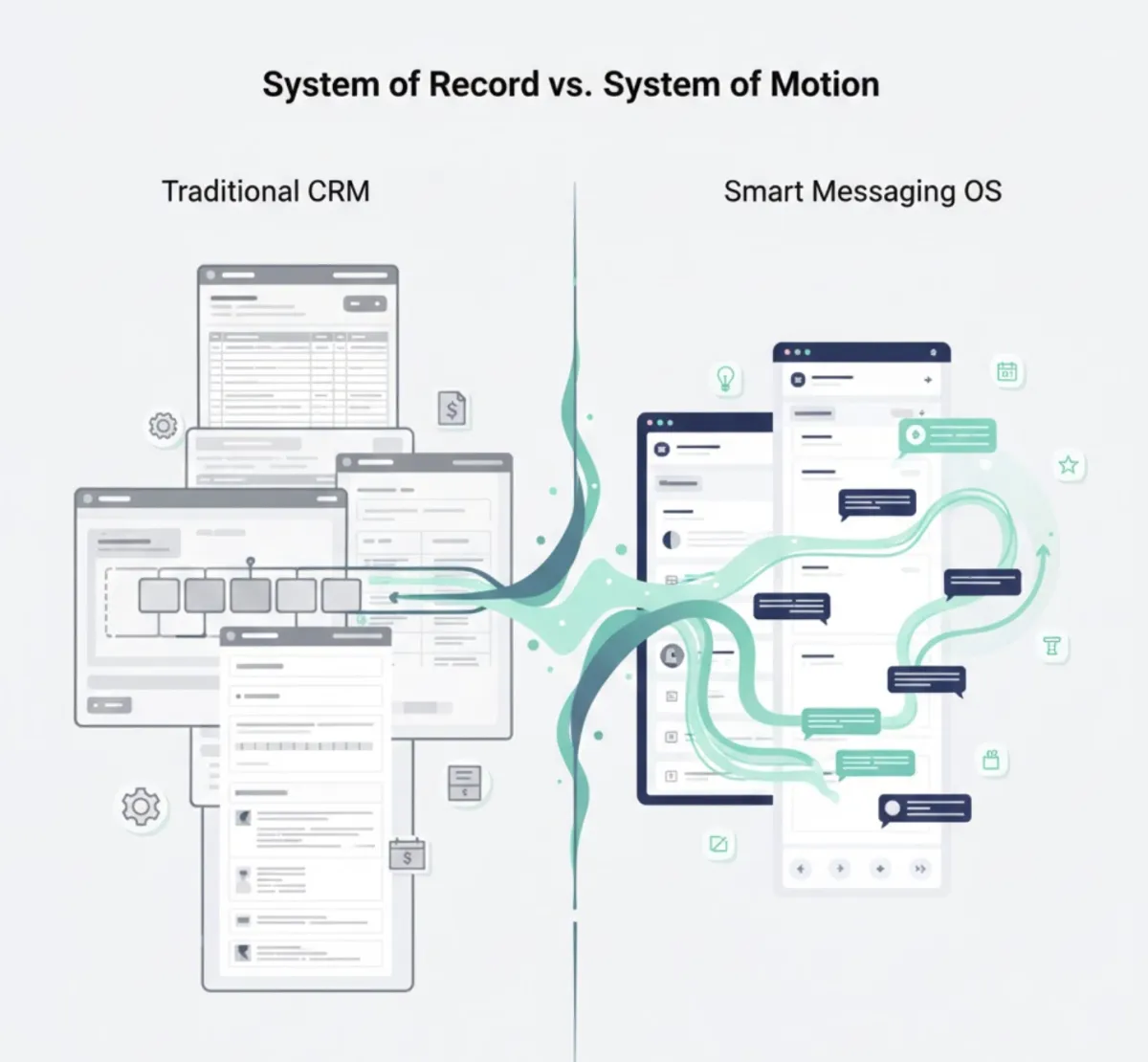
FlowChat vs. Salesforce: Why a Smart Messaging OS Beats a Traditional CRM for Social Selling
Salesforce didn’t fail.
It just wasn’t built for how people actually sell now.
Traditional CRMs were designed for a world of:
inbound forms
scheduled calls
linear deal stages
email-first communication
But social selling doesn’t work that way.
It lives in:
DMs
comment threads
follows, replies, silences
conversations that start casually and turn serious over time
And that’s where the gap begins.
This article breaks down why a Smart Messaging OS like FlowChat outperforms a traditional CRM like Salesforce for social selling - and why trying to force DMs into a legacy CRM quietly kills revenue.
The Core Difference: Systems of Record vs. Systems of Motion
Let’s start with the real distinction.
Salesforce is a system of record.
It’s excellent at documenting outcomes after something happens.
FlowChat is a system of motion.
It’s built to guide conversations while they’re happening.
That difference matters more than any feature list.
CRMs answer questions like:
“What stage is this deal in?”
“Who owns this account?”
“What’s the forecast?”
Smart Messaging OS platforms answer:
“Who needs a follow-up right now?”
“What context matters before I reply?”
“Where is this conversation drifting - or stalling?”
One tracks history.
The other shapes momentum.
Why CRMs Break Down in Social Selling Environments
Salesforce assumes a clean handoff:
Lead captured
Data entered
Opportunity created
Sales process begins
But social selling doesn’t announce itself.
Most revenue conversations start as:
a reply to a post
a follow-up after a follow
a DM that doesn’t feel like sales
CRMs struggle here for three reasons:
1. Conversations Don’t Fit “Fields”
Social DMs are fluid.
Context-heavy.
Nonlinear.
Trying to log them into rigid objects like:
Lead
Contact
Opportunity
...this forces reps to choose structure too early.
Result?
Important signals get lost or ignored.
2. Timing Is Invisible
CRMs don’t surface urgency well.
They don’t know:
who replied yesterday
who went silent after showing intent
who needs a nudge vs. space
Social selling is about timing, not stages.
Miss the moment, and the deal cools quietly.
3. Reps Stop Updating the System
This is the dirty secret.
When systems don’t match reality, humans adapt.
Reps:
keep context in their heads
rely on memory
scroll inboxes manually
forget follow-ups
The CRM becomes a graveyard of outdated truth.
What a Smart Messaging OS Does Differently
A Smart Messaging OS isn’t trying to replace your CRM.
It’s solving a different layer of the problem.
FlowChat is built around three principles:
1. Conversation-Centric, Not Record-Centric
FlowChat treats every DM as a living thread - not a data object.
It tracks:
intent signals
engagement state
conversational momentum
So sellers know what to do next, not just what already happened.
2. Visual Pipelines for Human Judgment
Instead of static deal stages, FlowChat uses visual DM pipelines.
You can instantly see:
who’s warming up
who’s stalled
who’s ready for a call
who should be released
No guessing.
No inbox chaos.
3. Automation That Assists - Not Replaces - Humans
Salesforce automates process.
FlowChat automates awareness.
The system:
flags follow-ups
surfaces context
protects timing
supports permission-based transitions
The human still decides what to say.
That’s the difference between scaling and spamming.
Social Selling Requires a Different Operating System
Salesforce shines after a deal is defined.
FlowChat shines before a deal exists.
That’s not competition - that’s sequencing.
For modern social selling teams:
FlowChat runs the front half of the relationship
Salesforce records the back half of the transaction
Trying to use Salesforce alone for social selling is like:
using accounting software to manage conversations
tracking chemistry with spreadsheets
The tool isn’t wrong.
It’s just pointed at the wrong problem.
When Salesforce Still Makes Sense
Let’s be clear.
Salesforce is still powerful when:
deals are already qualified
sales cycles are formal
handoffs are structured
forecasting matters
But expecting it to:
manage DMs
guide timing
preserve conversational nuance
...is asking a filing cabinet to run a conversation.
The Real Question Founders Should Ask
It’s not:
“Which tool is better?”
It’s:
“Where does revenue actually start for us?”
If revenue starts in:
comments
replies
DMs
social interactions
Then you need a Smart Messaging OS before a CRM.
Final Thought: Don’t Log Conversations. Lead Them.
Social selling isn’t about data entry.
It’s about:
momentum
context
timing
trust
A CRM records outcomes.
A Smart Messaging OS creates them.
If your team is drowning in inboxes, missing follow-ups, or relying on memory to close deals, the problem isn’t discipline.
It’s architecture.
And architecture always wins.
Happy Selling,
-sean 🔥🕺
For a deeper dive into Sell by Chat®, CLICK THIS LINK.


