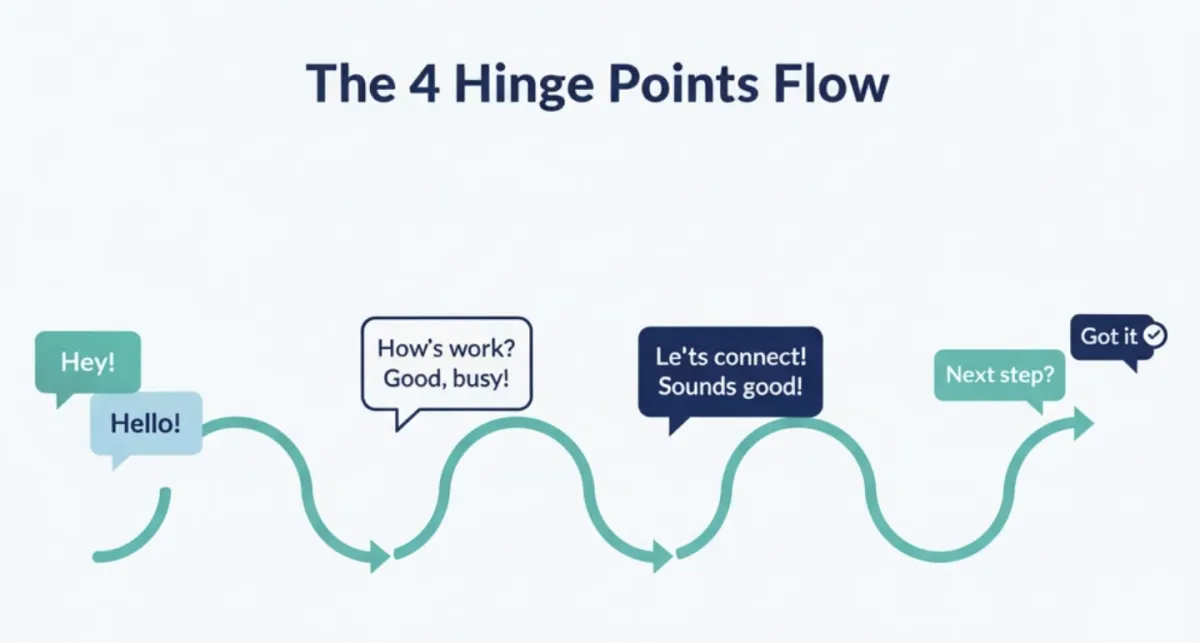
The 4 Hinge Points: Transforming Casual Chats Into Life-Changing Sales
Bad offers typically don't cause sales conversations to fail.
They fail because the conversation never turns.
It stays friendly.
It stays polite.
It stays casual.
And then…
...it dies.
The difference between a DM that goes nowhere and one that changes revenue isn’t pressure or persuasion.
It’s knowing when, and how, to hinge the conversation forward.
That’s what the 4 Hinge Points are for.
They’re not scripts.
They’re moments.
Miss them, and the chat drifts.
Hit them, and momentum becomes inevitable.
What a “Hinge Point” Really Is
A hinge point is a natural moment of transition in a conversation.
It’s when:
Casual becomes intentional
Social becomes directional
Interest becomes opportunity
Most sellers either:
Skip hinge points entirely, or
Force them awkwardly
Professionals recognize them, and move smoothly through them.

Hinge Point #1: "Engagement"
Goal: To get a response.
(We also like to lower defenses and establish relevance if you possible.)
Mistake to avoid: NEVER pitch in the first message.
---
This is where most conversations should start...
...but don’t.
The human entry (engagement message) isn’t:
“Hey, I help businesses scale…”
“Just wanted to introduce myself…”
It’s needs to contain context + humanity.
You’re answering the unspoken question:
“Why are you talking to me right now?”
Examples that can work well:
Referencing a specific post, comment, or story
Acknowledging something real about their business
Making the interaction feel earned, not random
The best Engagment message?
A compliment!
(Experts proved all the statistics behind this one)
As you can imagine, if this hinge doesn’t happen cleanly, nothing else matters.
And you'll probably get 'ghosted'.
Hinge Point #2: "Transition"
Goal: Move the convo from "Hey, how's it going" into questions that qualify/dis-qualify.
(You have control in deciding whether the conversation should move forward)
Mistake to avoid: Chit-chatting forever
---
This is the most dangerous hinge point.
You’ve got engagement, but no direction yet.
This is where the Good-Good-Bad pattern belongs:
Start with vision (future)
Example: "Wondering what your big goal for growth for your business is, this year?"Acknowledge momentum (what’s working)
Example: "Makes sense. What's worked best so far?"Introduce contrast (what’s holding them back)
Example: "I see. This makes me want to learn what you think is the bottle neck atm?"
You are not qualifying to sell.
You are sorting to see if you should continue.
If there’s no real problem here, you exit gracefully.
That’s a win.
Hinge Point #3: "Invite & CTA"
Goal: Move from chat to next step without pressure
Mistake to avoid: Ambushing with a pitch or link
---
This hinge point only works after clarity exists.
If you can clearly articulate:
Where they are
Where they want to go
What’s in the way
You can build a DM with the invite AND the CTA link in the same message...
...or, you can split them.
Use your gut to determine which is the better choice.
Doing this makes the convo flow in an "obvious" fashion.
Not:
“Want to book a call?”
But:
“I might be able to help with that. Want to walk through what I’m seeing together?”
OR (include both the invite and link):
"I didn't think you were gonna say that.
I just helped someone with this yesterday.
Let's hop on zoom so I can share what we did.
Book a time here: [LINK].
Let me know when you book, ok?"
Permission beats persuasion every time.
If they say yes, momentum accelerates.
If they hesitate, you don’t force it.
Hinge Point #4: "Clear Future"
Goal: Give them the EXACT next thing to do.
(This should preserve momentum and avoid drop-off)
Mistake to avoid: Assume they know what to do.
It's your job to tell them what to do.
(and what they should expect)
---
Most deals don’t die from rejection.
They die from lost continuity.
This hinge point is about:
Clear next steps
Timely follow-up
Context preservation
Chat is asynchronous.
Life gets busy.
Professionals design for that.
Make sure you provide them a simple, next step, that's easy to execute.
Example: "Excited you booked, [first_name]! We will chat on next Tuesday. Before the call, watch this quick 2 min vid. [LINK] It may help spark topics/questions we should chat about. Sound good?"
Why the 4 Hinge Points Matter

Funnels treat everyone the same.
Conversations don’t.
The 4 Hinge Points allow you to:
Personalize without freelancing
Scale without sounding scripted
Use automation to support humans, not replace them
When these hinge points are respected, sales stops feeling pushy and starts feeling…
...clean.
The Real Transformation
When founders master hinge points:
Conversations shorten
Conversion rates rise
Burnout drops
Confidence increases
Not because they “sell harder.”
But because they move conversations forward at the right moments.
That’s what life-changing sales actually look like.
Final Thought
If your DMs feel busy but unproductive, you don’t need more leads.
You need better hinge points.
Master the moments where conversations turn, and everything downstream changes.
Happy Selling!
-sean 🔥🕺
P.S. The biggest upgrade most sales teams can make isn’t a new funnel or offer. It’s learning when to stop talking… and when to move.
Want more juicy bits about this topic?
Go check out this article...
https://www.flowchat.com/sell-by-chat


