TryKondo Alternatives: How to Bridge the “Intent Gap” That Data & Inbox Tools Miss
Tools like Kondo exist for a real reason.
LinkedIn inboxes are a mess.
Too many conversations.
Too many follow-ups.
Too much context spread across tabs, notes, and memory.
So inbox acceleration tools promise relief, right?
They tell you, "use our tech and you'll get":
Faster replies
Cleaner inboxes
Zero missed follow-ups
And to be clear: that’s valuable.
But speed alone doesn’t solve the most important problem in social selling.
Intent.
What Kondo Actually Does (And Does Well)
Let’s ground this in reality.
Kondo positions itself as “Superhuman for LinkedIn DMs.”
That’s an accurate description.
Kondo helps with:
Splitting inboxes to prioritize conversations
Snoozing messages so follow-ups aren’t forgotten
Moving faster with shortcuts and snippets
Syncing DM data to tools like CRMs, Notion, or Clay
In short, Kondo is an inbox acceleration layer.
It helps you move faster inside LinkedIn DMs.
That matters.
But it’s also where the limitation shows up.
The Problem Speed Can’t Solve
Speed answers one question well:
“How fast can I process what’s already happening?”
Social selling requires a different question:
“What should happen next?”
That gap...
...between activity and judgment, is the "Intent Gap".
And no inbox tool, no matter how fast, can fill it on its own.
What the Intent Gap Actually Is

The intent gap isn’t about missing data.
It’s about missing situational awareness.
Intent shows up in moments like:
Someone replying quickly vs slowly
Someone answering with detail vs deflection
Someone asking questions vs avoiding them
Someone engaging publicly but hesitating privately
None of that lives in:
Job titles
Firmographics
Enriched fields
Inbox labels
Intent lives in conversation flow.
And flow is invisible unless a system is designed to track it.
Why Inbox Tools Aren’t Designed to Solve Intent
This isn’t a knock on Kondo.
It’s a category distinction.
Inbox tools are designed to:
Reduce admin
Increase responsiveness
Prevent missed follow-ups
They are not designed to:
Decide when to advance a conversation
Identify readiness vs curiosity
Signal when to pause or exit
Preserve why a conversation started in the first place
They assume the human will make those decisions manually.
Which works, until scale enters the picture.
What Happens at Scale
As volume increases:
Memory becomes unreliable
Judgment becomes inconsistent
Follow-ups become reactive
Conversations blur together
Teams compensate by:
Adding more labels
Moving faster
Sending more messages
Ironically, this increases activity while decreasing clarity.
The inbox stays clean...
but, the pipeline stays unclear.
And not having clarity, kills everything.
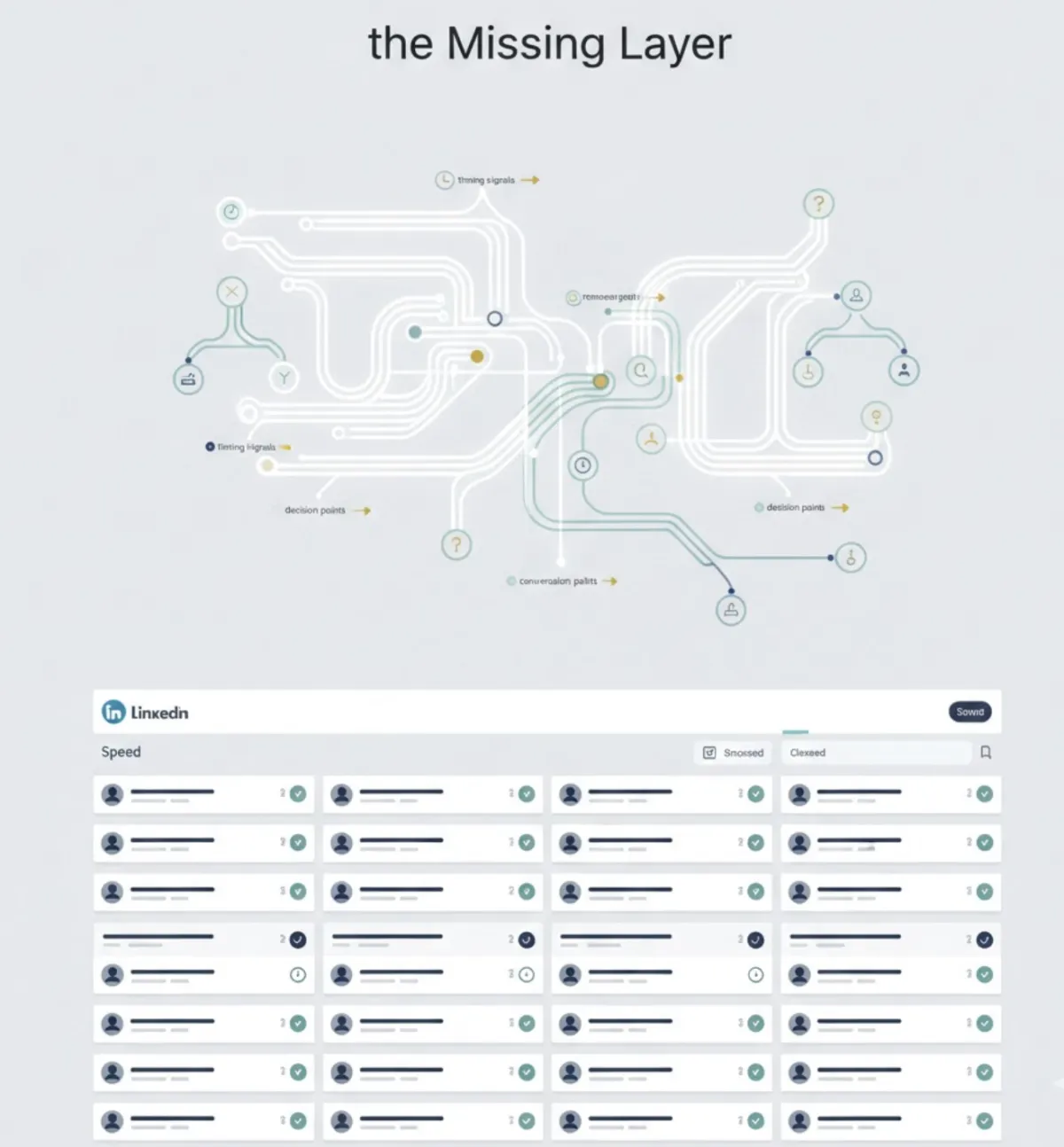
The Missing Layer: Intent Infrastructure
This is where most teams looking for “TryKondo alternatives” are actually stuck.
They don’t need a faster inbox.
They need a system that:
Preserves context across time
Tracks conversational signals
Highlights decision points
Separates curiosity from readiness
Supports human judgment instead of replacing it
That layer sits above the inbox.
Where FlowChat Fits (And Why It’s Complementary, Not Competitive)
FlowChat isn’t trying to replace inbox tools.
It’s designed to solve a different problem.
FlowChat focuses on:
Conversation state, not just messages
Intent signals, not just activity
Progression, not just speed
Human-in-the-loop decision points
Where Kondo accelerates replying, FlowChat supports deciding.
Used together, they’re powerful.
Used alone, inbox tools still leave teams guessing.
Data Helps. Speed Helps. Judgment Closes.

Most sales tech-stacks over optimize for:
Data completeness
Inbox efficiency
Automation speed
But deals don’t move because data is complete.
They move because:
Timing is right
Permission is earned
The next step is appropriate
A human shows up at the right moment
That’s not something you can label or snooze your way into.
The Real Question to Ask
If you’re evaluating TryKondo alternatives, the real question isn’t:
“Which tool is faster?”
It’s:
“Do we have a system that knows when a conversation should move forward, and when it shouldn’t?”
If the answer is no, the bottleneck isn’t your inbox.
It’s your intent layer.
Final Thought
Kondo makes LinkedIn DMs faster and cleaner.
That’s a real win.
But speed without situational awareness just means you get lost quicker.
Social selling doesn’t break because teams are slow.
It breaks because they don’t know what moment they’re in.
Inbox tools organize messages.
Intent systems guide conversations.
If your DMs feel busy but unpredictable, you don’t need more enrichment or more speed.
You need a way to bridge the intent gap.
Happy Selling,
-sean 🔥🕺
P.S. If your best sales conversations are happening in DMs but your team can’t tell which ones deserve attention right now, that’s not a discipline issue. It’s a system design issue.
For more info on the systems that allowed us to close more than $200M through DMs, CHECK THIS OUT.


